





Direct answer: verify factory ownership through three separate questions: who owns or leases the land and building, who owns or controls the production assets, and who employs and directs the manufacturing organization. A supplier can be a genuine manufacturer in a leased factory; owning property does not prove that it manufactures pellet machines. Use official property or lease records, corporate registration, asset evidence, payroll or employment evidence where lawful, utilities, permits, live observation, and an independent site audit.
“Owns the factory” has several meanings
Salespeople may mean the company owns the real estate, a parent company owns it, the business holds a long lease, or the company controls production in a partner facility. Buyers often assume these are identical. They are not. Ask the supplier to define the relationship in writing and name every legal entity involved.
A long-term leased facility with company employees, equipment, engineering, quality systems, and production control can be a real factory. A company can also own a building but rent space to unrelated manufacturers and act mainly as a seller. Operational control matters more than a simplified ownership label.
Build an entity-and-asset map
List the contracting seller, brand owner, registered manufacturer, property owner, tenant, equipment owner, employer, certificate holder, exporter, bank beneficiary, and warranty issuer. Show ownership or contractual relationships between them. Request records appropriate to each link and verify key details independently.
Names should reconcile across business license, address, quotation, drawings, nameplates, invoices, packing lists, certificates, website, and bank documents. Differences can be legitimate in a group structure, but unexplained differences weaken evidence.
Verify the land and building relationship
Request a property ownership certificate, land-use or facility record, or lease agreement as applicable, with sensitive commercial terms redacted. Match legal name, address, plot or building description, dates, signatures, and validity. Use official registry access or qualified local counsel or due-diligence provider where necessary.
A photo of a sign on a building proves little. Ask whether the company occupies the full site or one workshop, how long it has operated there, and whether the lease covers the expected project and warranty period. If the parent owns the property, document the subsidiary’s right to use it.
Verify production assets
Request a redacted fixed-asset list, equipment purchase invoices, finance or lease records, maintenance logs, calibration records, insurance schedules, or tax evidence where lawful and appropriate. Select several visible machines at random and match make, model, serial number, and location to records.
Asset ownership is not essential for every machine; leased CNC equipment can be legitimate. The question is who controls scheduling, maintenance, operators, programs, quality, and output. A supplier that only books time at another factory must disclose that dependency.
Verify the workforce and management control
Ask which entity employs production, engineering, quality, warehouse, and commissioning staff. Review organization charts, role descriptions, badges, training or qualification records, and anonymized employment evidence where permitted. Interview staff during an independent visit and confirm who assigns work and approves records.
A facility staffed entirely by another company may still be a controlled subcontractor, but the seller should not call those workers its own without explanation. The contract must state who is accountable for design, quality, delivery, and warranty.
Use utilities and permits as supporting evidence
Factory utility accounts, industrial permits, environmental documents, fire or safety records, and local registrations may help connect an entity to a location and activity. Check names, addresses, dates, and scope. These records are supporting evidence only; a permit can remain valid while activity changes, and utility consumption does not prove a specific product.
Compare declared production volume with plausible equipment, staffing, shifts, power use, storage, and shipping. Do not expect exact reconciliation from limited documents, but large contradictions deserve investigation.
Conduct a live and independent site verification
Start outside with address and signage, then maintain an unbroken route through the facility. Select machines, work orders, staff, and records at random. Ask to see areas not included in promotional tours, within safety and confidentiality limits. Confirm whether other brands or companies operate in the same building.
For a material purchase, hire an independent local auditor to verify the entity map, facility relationship, assets, personnel, manufacturing processes, and records. The audit scope should be written by the buyer, not limited to a general social-compliance certificate.
Interpret the supplied photograph accurately
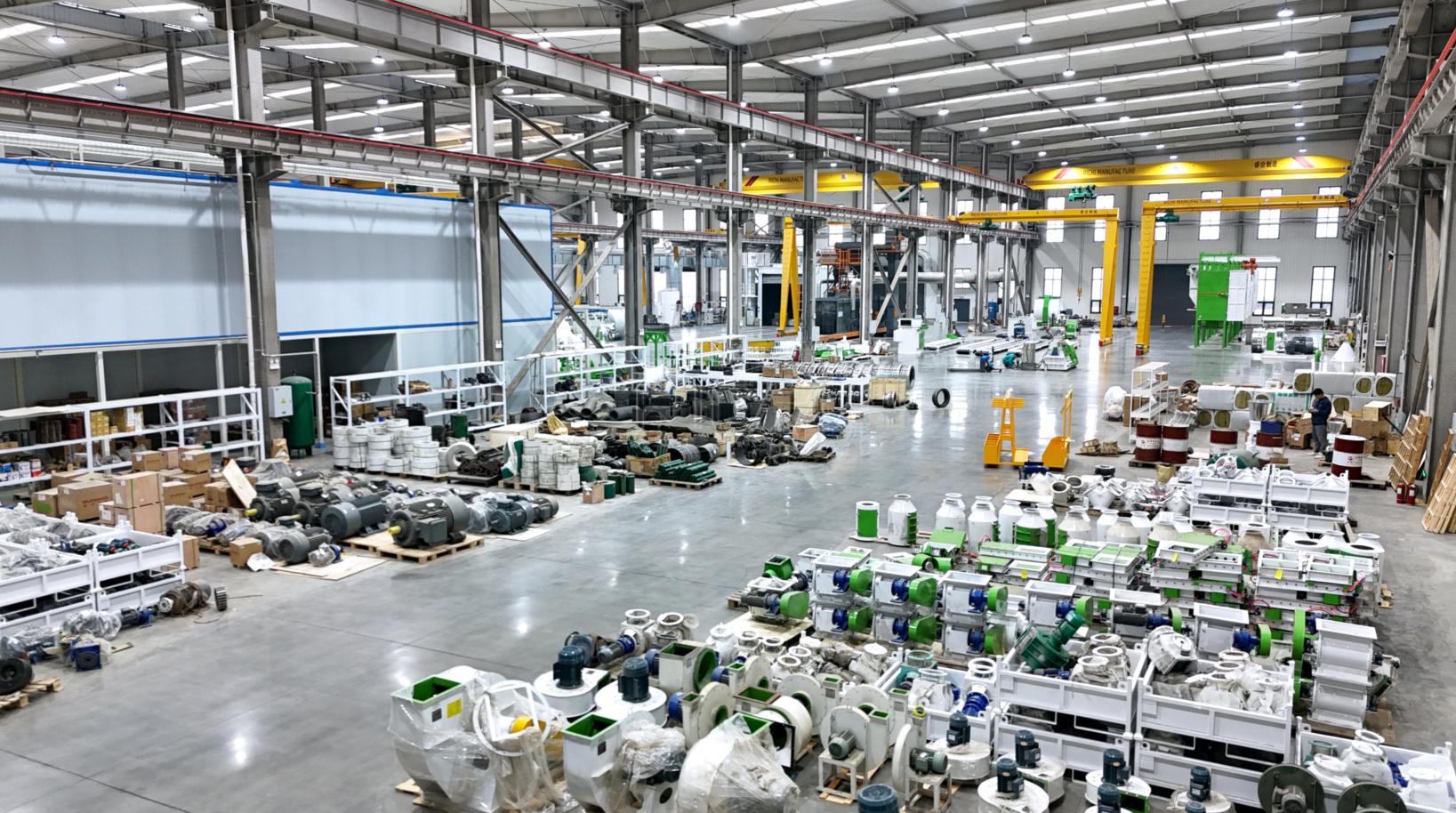
The supplied image shows a large pellet-equipment workshop with machines, motors, parts, cranes, and staff. It is consistent with manufacturing activity at the photographed moment. It does not identify the property owner, tenant, asset owner, employer, date, or legal entity. A photograph cannot prove factory ownership.
The visual can be used to select verification targets: overhead cranes, production machines, work areas, equipment nameplates, and the facility layout. Ask the live host or auditor to match these features and then review records tied to them.
Trace one order through the factory
Select a current order and follow quotation entity, approved drawing, production release, material, machining, fabrication, assembly, inspection, test, nameplate, packing, invoice, and shipment. The legal and operational entities should fit the disclosed map. This chain proves manufacturing control more directly than property alone.
If work is subcontracted, identify the purchase order, specification, incoming inspection, and approval. Controlled outsourcing is not evidence against manufacturer status; hidden outsourcing and false ownership claims are.
Check continuity and encumbrance risk
Ask whether the facility or major assets are mortgaged, financed, subject to disputes, scheduled for relocation, or shared under arrangements that could interrupt production. Not every buyer needs deep financial diligence, but a large deposit and long project justify checking continuity with professional advice.
Review lease expiration, renewal rights, relocation plans, and current workload. A factory relationship valid today may not cover the project’s fabrication, warranty, and parts period. Contract remedies should address material changes in manufacturing location or control.
Factory-control evidence checklist
- Written definition of ownership, lease, and operating control.
- Legal entity and relationship map.
- Property or lease record matched to address.
- Sample production-asset records matched to serial numbers.
- Workforce and management control evidence.
- Utilities and permits matched to entity and activity.
- Live unbroken factory verification.
- One-order trace through production and shipment.
- Independent audit for high-value orders.
- Continuity review covering project and warranty period.
Red flags
Be cautious when the supplier refuses to name the property owner, changes the factory address, cannot match assets to records, shows only office or showroom images, uses the same facility under unrelated brands, cannot explain who employs staff, routes payment to an unrelated entity, or prevents independent inspection.
One red flag may have an explanation. Several inconsistent links—entity, address, assets, staff, documents, and bank—indicate that the claimed ownership story is unreliable.
Confirm historical continuity at the address
Collect dated evidence over several years: registry address history, archived website pages, utility or permit dates, equipment maintenance records, employee tenure, shipment documents, and time-stamped imagery. A consistent history strengthens the claim that the facility is an operating base rather than a short-term borrowed tour location.
Address changes are not automatically suspicious; manufacturers expand or relocate. Ask for the timeline and how drawings, assets, staff, warranties, and parts support moved. Verify that the current quotation and certificates use the correct site where required.
Distinguish parent ownership from subsidiary control
A parent company may own the land and assets while a subsidiary employs staff and sells machines. Request organizational records and an intercompany use or service agreement appropriate to the transaction. Determine whether the seller has authority to schedule the factory, use intellectual property, issue warranty, and obtain parts after delivery.
Do not assume a shared brand creates legal recourse against every affiliate. The contract should name the liable entities, governing law, dispute route, and any guarantee from the asset-owning or manufacturing company. Use qualified legal advice for material orders.
Triangulate shipping and production activity
Sample recent packing lists, export declarations, freight records, customer acceptance documents, and serial numbers with confidential details redacted. Compare shipment frequency and product descriptions with visible work and claimed capacity. The objective is not to audit revenue but to determine whether the factory routinely produces and ships relevant equipment.
Remember that export companies and freight forwarders can appear on documents. Reconcile them with the entity map. A consistent explanation across production, invoices, and shipping is stronger than any single record.
Control location changes after award
Write the approved manufacturing location and critical subcontractors into the quality plan. Require notice and approval before work moves. Preserve inspection rights and repeat key checks if the location changes. The buyer selected not only a machine design but also a production system and quality environment.
At pre-shipment inspection, confirm facility, serial numbers, work records, and nameplates again. This closes the gap between prequalification evidence and the equipment actually shipped.
Final decision
Do not make property ownership the sole pass/fail test. Verify that the supplier truthfully describes the factory relationship and controls the engineering, people, equipment, quality, schedule, and warranty required for your order. A transparent leased manufacturer can be safer than an opaque property owner.
The strongest proof combines official facility records, asset and workforce samples, live production, an order trace, and independent confirmation. Together they show who owns what—and, more importantly, who can deliver the machine.